
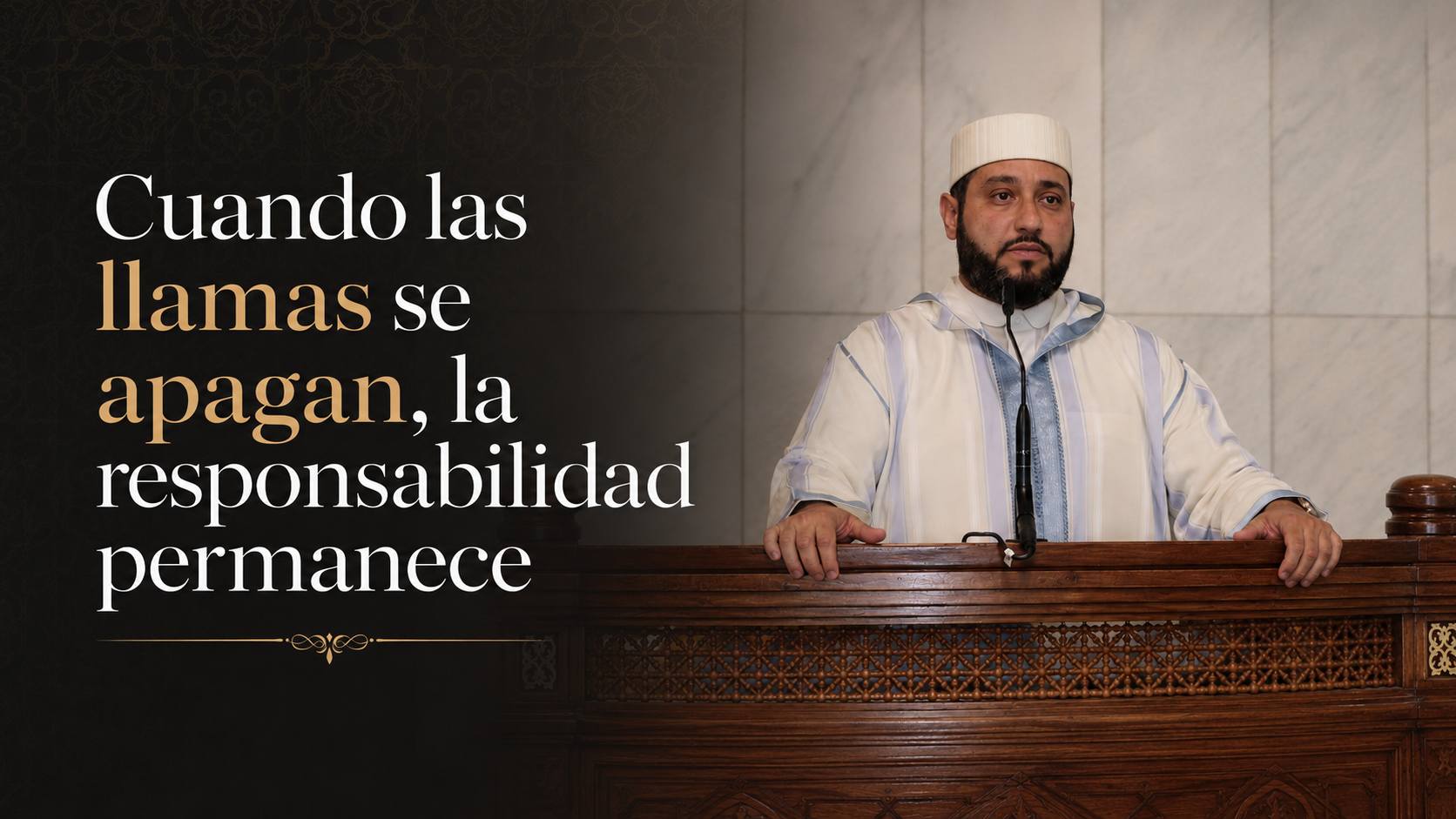
When the flames die down, the duty remains
We praise Allah, Lord of the worlds, and ask that peace and blessings be upon our last Prophet ﷺ and Messenger, Muhammad, upon his family, his companions and all those who follow his path until the Day of Judgement.
Dear believing brothers and sisters: in recent weeks, Madrid and some of the surrounding areas have suffered fires that have caused damage to nature and to a great deal of property, and that have brought fear and worry to many families and residents.
Thanks be to Allah, subḥānahu wa taʿālā, the flames have been put out. And we must also thank the firefighters, the rescue teams, the doctors and nurses, the volunteers, the security officials and the authorities who have made great efforts to protect people's lives and attend to the affected areas.
But today, now that the flames have died down, another duty remains: not to forget those who are still suffering the consequences. To stand by families in need, to help our neighbours and to turn concern into mercy, and mercy into useful and lasting action.
The test does not end when the last spark goes out
The flames may go out. The smoke may clear. The sound of emergency vehicles may no longer be heard. Yet the consequences of a calamity do not disappear in a week or two.
Behind every damaged home there is a family that needs someone to ask after them. There are people who have lost belongings, peace of mind and security, and who still need support when the cameras have gone and other people's attention has turned elsewhere.
The test does not end when the last spark goes out. Then begins the duty of loyalty, the responsibility of accompanying those who suffer and the obligation to bring hope back to hearts.
Allah, the Most High, commands us to cooperate in goodness and in awareness of Allah, and not to cooperate in sin and aggression (Quran, 5:2). Goodness also means remaining steadfast in doing good, being loyal to those who need help and continuing to ask after our neighbour after others have stopped paying attention.
The right of the neighbour in times of calamity
Within our Muslim community there are families who have suffered damage and whom modesty and dignity may prevent from asking for help. But in the towns around Madrid there are also neighbours of different religions and backgrounds who have suffered the same fear and the same losses.
The duty of the Muslim is to be a mercy to those around them and to ask after a person in need because of their need, not because of their name, their colour, their origin or their religion.
The Prophet ﷺ said that the archangel Gabriel kept urging him to treat neighbours well, to the point that he thought he would make them heirs. The right of the neighbour therefore holds an enormous place in Islam, and that right becomes even more important in times of fear, illness and calamity.
It is not part of treating a neighbour well to hear that they need help and not ask after them. Nor to know that a family has lost some of their belongings and think that it is someone else's business.
The sincere believer does not live only for themselves, but also carries in their heart concern for those around them.
Allah helps those who help
The Prophet ﷺ taught that Allah helps His servant as long as the servant helps his brother. He also taught that whoever attends to his brother's need will find Allah's help, and that whoever relieves another's hardship will find relief in his own difficulties.
Helping a person in need, discreetly protecting a family, easing someone's distress or bringing hope back to the heart of someone afflicted are actions whose value can go far beyond what we see in this world.
That is why, when a calamity strikes those close to us, we should not only ask what has happened. We must also ask ourselves: what can we do now?
Helping without wounding dignity
Dear Muslim brothers and sisters: the help that Allah loves is the help that protects human dignity.
Allah, the Most High, warns the believers not to invalidate their charity by reminding others of the favour or by causing harm to those who receive it (Quran, 2:264).
Help must be given discreetly. We should take an interest in people's situation with tact, find out what they need without embarrassing them and always preserve their dignity. No one should have to lose their privacy or feel humiliated in order to receive our help.
It is not only about giving. How we give, how we ask and how we accompany also matter.
Thanking Allah and thanking those who serve
All of this is also part of gratitude. First of all, we thank Allah for having protected and helped us, and we acknowledge this blessing. But we must also recognise the merit of those who have served society and worked to protect our lives.
We thank the firefighters, the rescue teams, the doctors and nurses, the security officials, the volunteers and everyone who has given their time and effort to protect others and their property.
Gratitude must not remain only in words. It should also lead us to recognise the good that others do and to ask ourselves how we can contribute.
May our mosques be bridges of mercy
May our mosques be houses of worship of Allah, but also schools of good conduct, spaces of mercy and bridges of cooperation with our neighbours and with the whole of society.
The Prophet ﷺ taught that we should not belittle any good deed, however small it may seem to us. Sometimes we think our help is insufficient because we cannot completely solve a family's problem or repair all the damage caused by a calamity. But a good deed does not stop being good because it is small.
Asking after someone, accompanying them, offering them what they need, putting them in touch with someone who can help them or simply making them feel they are not alone can be of enormous value.
Turning concern into action
May our help reach every person in need, without distinction of religion, origin, language or nationality. Calamities remind us of our fragility, but they also give us the opportunity to show what kind of community we want to be.
The flames may go out, but our duty towards those who have suffered does not end with them. As long as there remains a worried family, a person in need or a neighbour who needs support, there is still an opportunity for mercy, solidarity and goodness.
We ask Allah, the Most High, to protect us from every calamity, to protect our families from all harm, to help us remember Him, thank Him and worship Him in the best way, and to grant relief and protection to those going through difficulties.
Original YouTube video:
https://www.youtube.com/watch?v=uho19N1PLTY