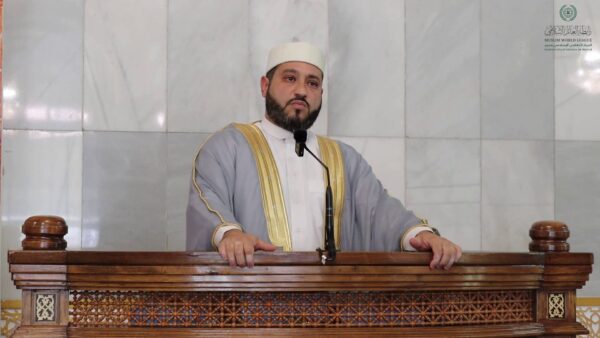
Alhamdulillah. All praise belongs to Allah, Lord of the heavens and the earth. We glorify Him, the One and Only, and we bear witness that there is nothing and no one that deserves to be worshipped except Allah, and that Muhammad ﷺ is His last Prophet and Messenger.
Zakat al-fitr: the charity that purifies the end of Ramadan
Dear brothers and dear sisters, in these last days of Ramadan we remember one of its great blessings: the Night of Decree, Laylat al-Qadr, a night whose value surpasses a thousand months of worship.
The Prophet ﷺ said that whoever prays on the Night of Decree with faith and hoping for Allah's reward will have their previous sins forgiven. That is why, in the odd nights of the last days of Ramadan, the believer should strive more than during the rest of the month: reciting the Holy Quran, making supplications, praying, remembering Allah and seeking everything that brings them closer to Him.
May Allah grant us the reward of this blessed night and allow us to end Ramadan with a heart that is alive, humble and sincere.
A charity prescribed at the end of Ramadan
At the end of Ramadan, Allah prescribed a charity in food for those who have fasted and are able to give. This charity is called zakat al-fitr.
Zakat al-fitr should not be confused with zakat al-mal. Zakat al-mal is related to wealth and possessions. Zakat al-fitr, on the other hand, is tied to the end of the Ramadan fast and has a very specific purpose: to purify the believer and to feed those in need on the day of Eid.
The Messenger of Allah ﷺ made zakat al-fitr obligatory on men and women, on young and old. It was transmitted as a measure of food, such as dates or barley, and was established to purify the person who fasted from the idle words, faults or indecent acts committed during the month, as well as to provide food for those in need.
Purifying the fast and bringing joy to the day of Eid
Zakat al-fitr has a very clear beauty: it does not remain only in the individual relationship of the believer with Allah. It also looks towards others.
On the one hand, it is a purification for the one who has fasted. During Ramadan, even if the believer makes an effort, they may have made mistakes, been careless, said bad words or committed faults. Zakat al-fitr comes to cleanse those imperfections of the fast.
On the other hand, it allows the poor and needy to have food on the day of Eid. Because Eid should not be a day of joy only for those who have plenty. The believer's joy is also made complete when they care about the joy of others.
When zakat al-fitr should be given
Zakat al-fitr must be given before the Eid prayer. Whoever gives it after the Eid prayer no longer gives it as zakat al-fitr, but as a simple sadaqa, a voluntary charity.
That is why it is recommended to give it in good time, even one or two days before Eid, as the companions of the Prophet ﷺ did. In this way, the help reaches those who need it before the appointed day and fulfils its purpose.
It is not a matter of giving in any way or to anyone without discernment. We must make sure it reaches those who are truly entitled to receive it and who need it.
The amount of zakat al-fitr
The measure traditionally mentioned is one sa‘, which is roughly equivalent to between two and a half and almost three kilos of staple foods, such as dates, barley, rice or similar products.
Most jurists consider that zakat al-fitr must be given in food. Other scholars consider it valid to give it in money, understanding that its purpose is to make it easier for the poor to meet their needs and live the day of Eid with dignity.
When it is calculated in money, the value of staple foods such as flour or rice is taken as a reference. In the context mentioned, the minimum guideline amount was about six euros for each member of the household.
Every Muslim who has sufficient food must pay zakat al-fitr. The head of the family, the parents or legal guardians may pay it on behalf of the other members of the family.
The last Friday of Ramadan should not pass like any other
Brothers and sisters, this is the last Friday of this sacred month of Ramadan. And the end of Ramadan should not find us the same as at the beginning.
Let us repent. Let us return to the path of Allah. Let us make sure that after Ramadan there is a real change towards something better.
Whoever can give up a bad habit, let them do so. Whoever can give up smoking, let them do so. Whoever can give up alcohol, let them do so. Whoever can better fulfil the commands of Allah, let them do so.
Ramadan does not come only to change our timetables. It comes to change our relationship with Allah, with ourselves and with others. The sad thing would be for the month to end and for us to remain in exactly the same place inside.
May Eid find us purer
May Allah accept our good deeds. May He guide us to His path. May He protect us from evil. May He accept our fasting, our prayers, our supplications and our charity.
May zakat al-fitr not be for us a mere obligation fulfilled in a hurry, but a sign of gratitude, of purification and of mercy towards those who have less.
May Ramadan not end only on the calendar. May it end by leaving something clean, firm and true within us.